
Types of Braces
Orthodontics can be carried out using many different appliances. Newer technologies and materials have improved the systems and the appearance of the orthodontic appliances available today for children and adults.
The choice offered often depends on whether you are seeing a specialist orthodontist or a general dentist.
The arch-wires vary in size and material and are changed as treatment progresses. The choice of arch-wire depends on the stage of your treatment and the particular situation. The aim is to achieve the tooth movements needed using as light a force as possible.
Braces consist of three main parts; a bracket, an arch-wire and a connector. The bracket, is a square base glued to the surface of each tooth, an arch-wire which joins the brackets, and finally, a connector which connects the arch-wire to the brackets. Different types of brackets, arch-wires and connectors can be used.
The connector can be made of:
- A rubber loop which is available in different colours. The main purpose of the different colours is to add a bit of fun and individuality to your brace. Ask Dr Manara what colours are available.
- A thin wire ligature. This is used to reduce friction or to have a more secure connection to the bracket.
- It can be part of the bracket. These are also called “self-ligating” brackets. The most commonly mentioned in the press in the Damon appliance™ . These braces have been around for a long time, and are very convenient in busy, high volume practices. This bracket includes a flap which locks the arch-wire in. The design means that the bracket is bulkier than a normal bracket. This can cause more rubbing. The claims that orthodontic treatment with these brackets is faster or mean that fewer teeth need to be extracted are false and not based on good independent scientific evidence.
Fixed braces
Fixed braces are attached to your teeth by your orthodontist. They give the best control to move your teeth, and can be placed on the inside or outside of your teeth.
Braces placed on the inside of the teeth are also called Lingual braces and the great thing is that they are totally invisible so your treatment can remain your secret. Win® is the latest lingual brace system and is truly state of the art.


Labial braces (outside)
Braces placed on the outside, is the more traditional method and are also referred to as Labial braces. They be made of metal (Stainless steel), Clear (Ceramic) or gold coloured. One type of labial brace, the Damon® appliance, tends to receives an inappropriate amount of press coverage for all the wrong reasons. It belongs to the family of labial braces that are self-ligating who’s only scientifically proven correct claim is that the wire can be fasted to the teeth a few seconds faster than the non self ligating braces. If you would like more detailed information about these type of brace Dr Manara will be able to expand on this in more detail.
Metal Braces
Metal braces are labial braces that are made from stainless steel. They are the most common type of orthodontic appliance, especially in children, and are commonly known as “Train tracks”. Great advances in this bracket type has occurred over the years making the bracket less bulky and smoother, and therefore more comfortable for you than what was available in the past.
Colours
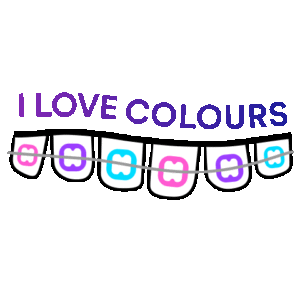
Coloured elastics can be added to the braces to make it more fun. Ask Dr Manara for your favourite colour at your next appointment.
Gold Braces
These are similar to metal braces but gold coloured. Some people find that gold is more aesthetically pleasing in the mouth than the silver metal colour.
Clear Braces
Clear or tooth coloured braces are made of a tooth coloured material such as ceramic. This gives them a tooth coloured appearance. Many adult choose this type of brace because of the relatively good aesthetics compared to metal braces.
Removable appliances
Removable appliances, as their name suggests can be removed by the patient usually for cleaning and eating. The duration of wear needed will vary from patient to patient.
There are several types of removable appliances.
Clear Aligners – Invisalign
Clear liners, such Invisalign™, are high-tech removable appliances which are thin and see through. They are customized serial liners designed to fit your teeth with a sequential movement built in. The liners are replaced every two weeks on average, providing a gentle force to move the teeth.
Dr Manara will advise you if this type of treatment is best for you. What it can achieve and what its limitations are in your case.
Traditional
Traditional removable appliances consists of an acrylic plate with clasps to hold the plate, and springs to move the teeth. They are mostly used in early orthodontic treatments for children such as to correct a single tooth or expanding the dental arch. A fun design for the plate can be chosen or you can even design your own and email it to us. Removable plates usually need to be worn all the time except for cleaning, eating, and sport. Dr Manara will advise you on this.
Inman
The ‘Inman’ removable appliance is a ‘Branded’ type of removable appliance. It consists of a hard acrylic base to which are connected wires and springs. It is usually used to correct irregular front teeth. Frequently a specialist orthodontist can offer a more effective and comfortable appliance than the Inman which can feel quite bulky in the mouth to many patients. The product is highly marketed to general dentists.